Tag: creators

  • Get Started with HYTOPIA: Monetization for Creators Explained

    Get Started with HYTOPIA: Monetization for Creators Explained

    HYTOPIA is built with creators in mind, and our monetization system reflects that commitment. Whether you’re designing the next viral cosmetic or crafting an engaging game economy, we’ve created tools to help you succeed.

    Here’s everything you need to know about earning on HYTOPIA.

    How Do You Make Money?

    Creators on HYTOPIA earn through two main channels:

    1. Marketplace Sales: Sell cosmetics, items, lootboxes, and bundles on the HYTOPIA Marketplace
    2. In-Game Microtransactions: Offer seamless purchases directly within your game experience

    When a player makes a purchase, it syncs instantly to their Locker and becomes available across all compatible experiences. You maintain full control over what you sell and how it integrates with your game’s economy through the Creator Dashboard.

    Launch Timeline: Monetization is expected to go live in November 2025. The marketplace is currently in alpha testing..

    Creator Revenue Splits

    Here’s where HYTOPIA truly stands apart. We believe in putting creators first, and our revenue splits prove it:

    Table illustrating the revenue splits for creators on HYTOPIA, showing 85% for primary sales and 15% for secondary royalties.

    Yes, you read that right, 85% of every first sale goes directly to you, with no platform fees eating into your earnings. These splits are designed to help creators thrive as HYTOPIA grows.

    Note: Splits are enforced immediately at checkout onchain and reflected in your dashboard’s sales analytics.

    What Can You Sell?

    1. Global Cosmetics

    Visual items like helmets, capes, backpacks, and gloves that are purely cosmetic by default (no gameplay advantage). You can specifically code them into your game mechanics if desired. Global cosmetics work across all HYTOPIA experiences unless a developer explicitly hides them.

    Important: Cosmetics must adhere to HYTOPIA’s blocky visual style and pass marketplace review. Check out our Styling & Assets guide for details.

    2. Non-Cosmetic Items

    Items that affect gameplay (power-ups, boosts, keys, consumables) without changing a player’s appearance.

    Pro tip: Non-cosmetic items are tradable, which means you can earn royalties when players resell them.

    3. Lootboxes

    Lootboxes provide a single random reward from your defined item pool. You set the items and rarities, and HYTOPIA’s system automatically calculates drop rates. Rarities range from Normal (100%-25%) to Utopian (0.5%-0%).
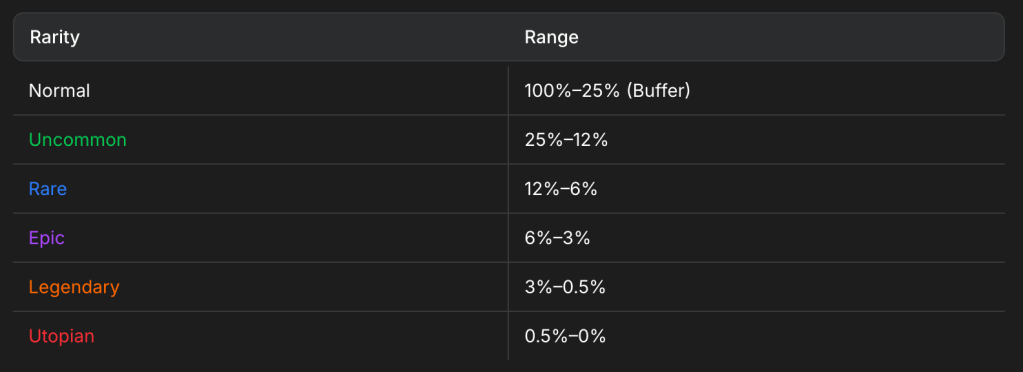
    Table displaying item rarity categories and their corresponding percentage ranges in a dark-themed interface.

    Example: Check out the Adopter’s Weapon Lootbox

    4. Bundles

    Curated sets of predetermined items with no randomness involved. Players know exactly what they’re getting (e.g., Desert Ranger Set). Once purchased, items unpack directly into the player’s Locker.

    Example: Golden Armor Bundle

    5. In-Game Microtransactions

    Perfect for quick, contextual purchases like extra lives, in-game currency, or revives. Players see a popup, select their payment method, and complete the transaction without leaving your game. You can configure these through your dashboard before implementation.

    Blockchain that Actually Works

    HYTOPIA uses blockchain technology for what it truly excels at; true player ownership and freedom.

    Here’s how it works:

    • Marketplace items exist as NFTs on the Base blockchain
    • Each player has a unique wallet tied to their account
    • Players can sell their items anytime, converting NFTs to USDC or $HYBUX
    • Funds can be withdrawn outside of HYTOPIA, no walled garden

    Unlike other platforms, HYTOPIA doesn’t trap your money. They enjoy genuine ownership and freedom. That’s how blockchain should work.

    You can learn more about HYTOPIA’s tokenomics.

    Best Practices

    Want to maximize your earnings? Here are proven strategies that work:

    1. Lead with Cosmetics

    Vanity sells. Build themed sets, seasonal drops, and mix-and-match slots so small purchases add up to complete looks.

    2. Create Starter Value

    Offer a low-price starter bundle ($1-$3) that kicks off a habit loop. Clear upgrade paths (Starter → Deluxe → Master) keep players engaged.

    3. Time-Limited Events

    Create urgency with event-driven drops tied to updates, new modes, or special rotations. First-time user quests that reward lootboxes work great too.

    4. Progression-Friendly Non-Cosmetics

    If you sell gameplay items, favor time-savers (XP boosts, convenience keys) over raw power. Cap stacking and time-limit boosts to maintain balance.

    5. Clean Shop UX

    Design a mobile-first layout. Avoid overwhelming carousels. Make it easy for players to find and buy what they want.

    6. Ethics = Retention

    Monetization should never block core fun. Avoid pay-to-win mechanics where possible and stay away from predatory gambling-style mechanics. Happy players stick around and spend more over time.

    Ready to Start Earning?

    Apply for the Creator Fund: Got a great game idea? HYTOPIA’s $250,000 Creator Fund is open for developmental grants. Apply here

    Learn More: Check out the full Dev Docs for styling guides, SDK documentation, and technical implementation details.

    HYTOPIA is building a creator-first platform where your work is valued and rewarded fairly. With industry-leading revenue splits, real player ownership, and powerful monetization tools, you have everything you need to turn your creative vision into a sustainable income.

    The future of game creation is here. Let’s build it together.

  • AI Agents & Text-To-Game Transform Voxel Development

    AI Agents & Text-To-Game Transform Voxel Development

    Hey HYTOPIA community!

    We’ve got something INCREDIBLE to share with you today. We’re excited to share our latest demo that showcases how developers can build rich multi-agent systems using HYTOPIA’s framework. Let’s dive in!

    Making Virtual Worlds Smarter

    Remember when game NPCs just walked back and forth on predefined paths? Those days are OVER! We are creating a framework that lets your AI agents think, interact, and live in your voxel worlds in ways that feel genuinely intelligent. Here’s what makes it tick:

    • Smart environment awareness (they know what’s around them!)
    • Natural interactions with players and other agents
    • Profession-specific behaviors (like fishing, mining, and more!)
    • Real-time decision making based on world state

    Let’s dive into how these components work together to create dynamic, responsive AI agents.

    World State Representation: Keeping Agents Informed

    For AI agents to make meaningful decisions, they need to understand their environment. In our demo, each agent maintains awareness of:

    • Their current location in the world
    • Nearby entities and objects
    • Status of their ongoing actions (“Behaviors”)
    • Personal inventory contents

    This environmental awareness allows agents to make contextually appropriate decisions and interact naturally with their surroundings.

    Actions: Defining Agent Capabilities

    We’ve implemented a straightforward but flexible action system that allows agents to:

    • Navigate to specific coordinates or named locations
    • Interact with other agents through speech
    • Perform profession-specific tasks (like fishing or mining)

    What makes our system unique is our approach to action implementation. While many frameworks rely on function calling, we’ve opted for XML-based action definitions. This choice offers several advantages:

    • Reduced token consumption
    • Natural integration with LLM outputs
    • Flexible parsing from free-form text
    • Preserved creative expression in language models

    LLMs: The Brain of the Operation

    Large Language Models serve as the decision-making core of each agent, processing state information and determining appropriate actions. We’ve implemented two primary triggering mechanisms:

    1. Response Triggers: Agents react immediately to player interactions, perfect for testing and small-scale implementations.
    2. Game Steps: A turn-based approach that scales better for larger player counts, where agents make decisions at regular intervals (e.g., every 5-10 seconds).

    https://twitter.com/HYTOPIAgg/status/1877402843411308706

    Practical Implementation

    Our demo showcases these concepts in action, featuring:

    • Multiple AI agents with unique pathfinding and behaviors
    • Visual chat bubbles for agent communication
    • A sidebar UI for monitoring agent actions

    The system demonstrates how agents can navigate to specific locations or seek out other agents by name, without requiring explicit coordinate knowledge.

    Ready to Build Your Own AI Agents?

    We’ve made it easy to get started with your own AI agent implementation. Check out our comprehensive example repository on GitHub:

    👉 HYTOPIA AI Agents Example Repository

    This repository contains everything you need to begin building your own intelligent agents, including the complete source code from this demo. Use it as a template to jumpstart your game’s AI development.

    https://twitter.com/HYTOPIAgg/status/1878955053241004439

    But Wait, There’s More: Introducing Text-To-Game (T2G)!

    This is HUGE! We’re taking game development to the next level with Text-To-Game (T2G) technology. T2G transforms the game creation process into a natural language conversation between you and AI, powered by our comprehensive developer SDK.

    How T2G Works

    • Natural Language Input: Simply type what you want to create in plain English
    • AI-Powered Generation: Our AI, trained on the HYTOPIA SDK, automatically generates the necessary code
    • Instant Visualization: See your changes come to life immediately in a live game window
    • Learn While Building: Watch and understand how the AI translates your ideas into functional game code

    https://twitter.com/iamarkdev/status/1878565808517116203

    Seamless Integration with Popular Editors

    T2G will be available as a HYTOPIA editor plugin for popular development environments like VSCode and Cursor. The plugin provides:

    • Automatic HYTOPIA dev server setup
    • Live game preview window within your editor
    • Instant updates as you make changes
    • AI assistance powered by comprehensive knowledge of our SDK documentation, guides, and examples

    This integration means you can stay in your preferred development environment while leveraging the full power of T2G technology.

    Looking Forward

    The combination of our multi-agent system and T2G technology marks a new chapter in game development, where the barrier between imagination and implementation is lower than ever before. Whether you’re a seasoned developer or just starting out, HYTOPIA provides the tools you need to bring your game ideas to life.

    Stay tuned for more updates as we continue to expand our framework capabilities and make game development accessible to everyone who can imagine it.